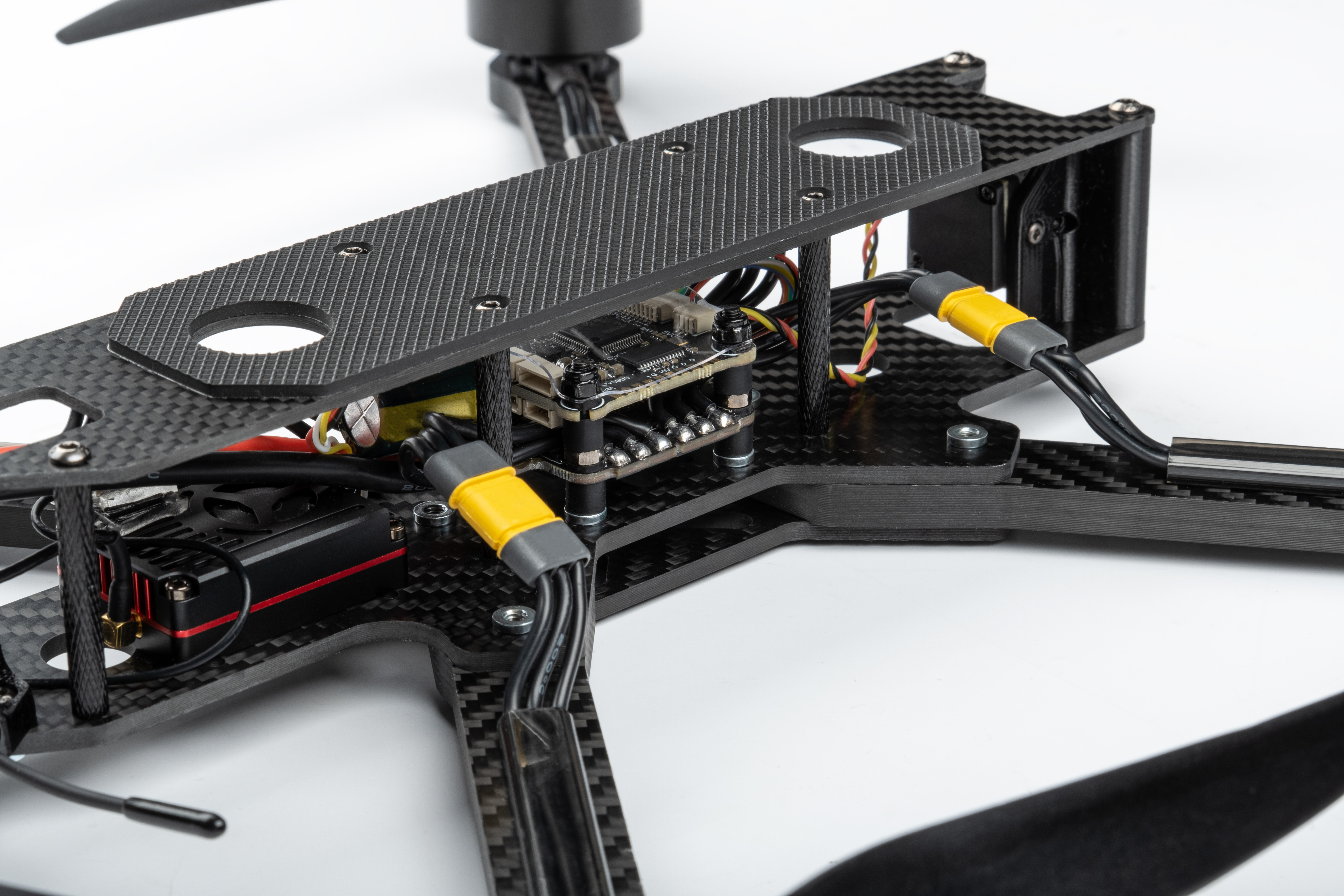
As drone technology continues to evolve, manufacturers are under pressure to build aircraft that are lighter, stronger, more durable, and capable of longer flight times. Material selection plays a major role in achieving those goals.
Whether the application is a consumer drone, industrial UAV, agricultural drone, public safety aircraft, or military UAV, the right combination of engineering plastics and composites can improve performance while reducing weight.
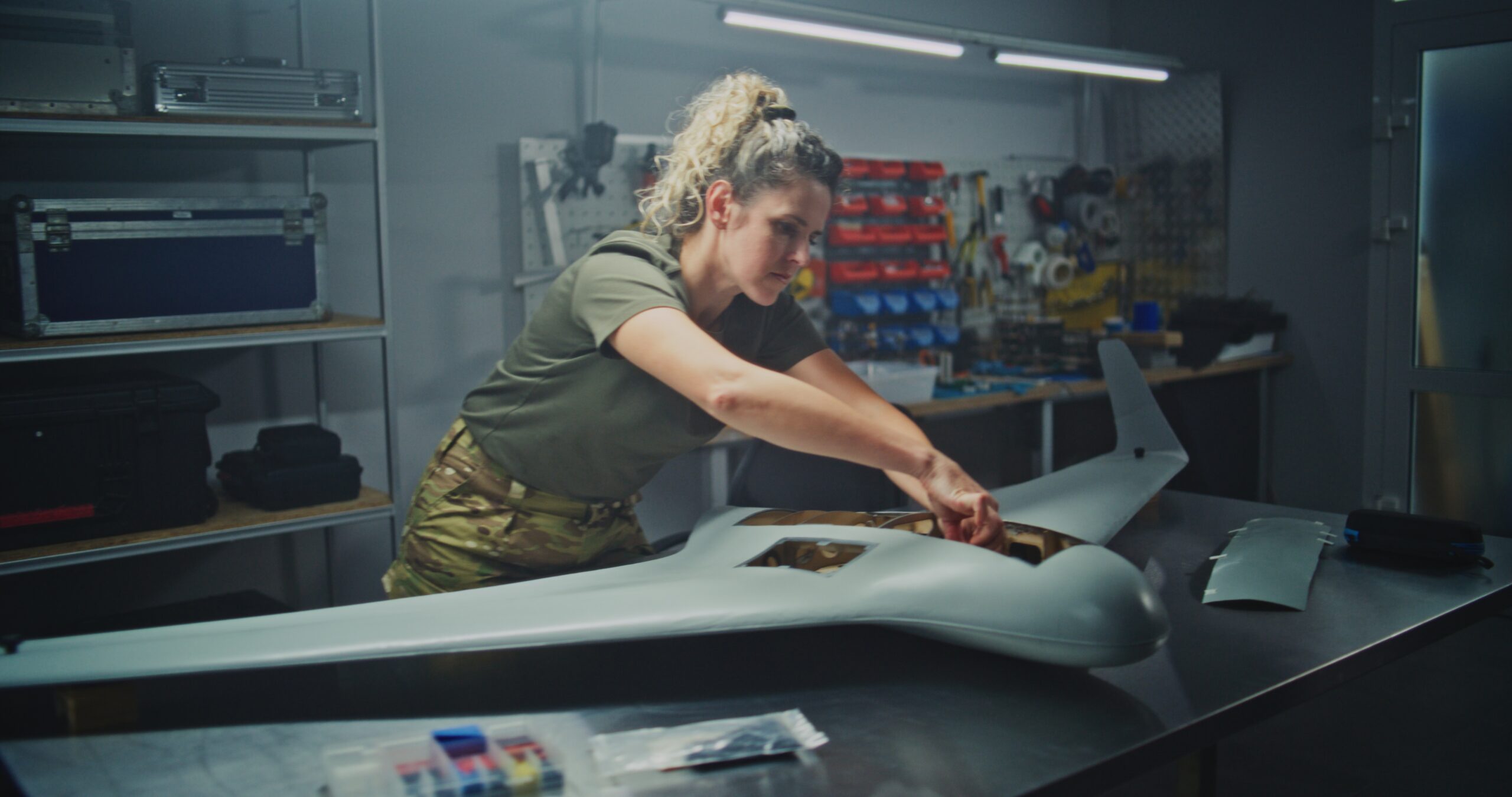
Need Help Selecting the Right Material for Your Drone Application?
Our expert customer and technical service teams are available to help with any technical or sales questions related to plastic and composite materials for drone applications.
Contact Us Call 1-800-444-3485Engineering plastics and composites are used throughout modern drones because they offer an excellent balance of mechanical performance, corrosion resistance, wear resistance, electrical insulation, and lightweight construction. Many of these materials also simplify machining and manufacturing while providing long service life in demanding operating environments.
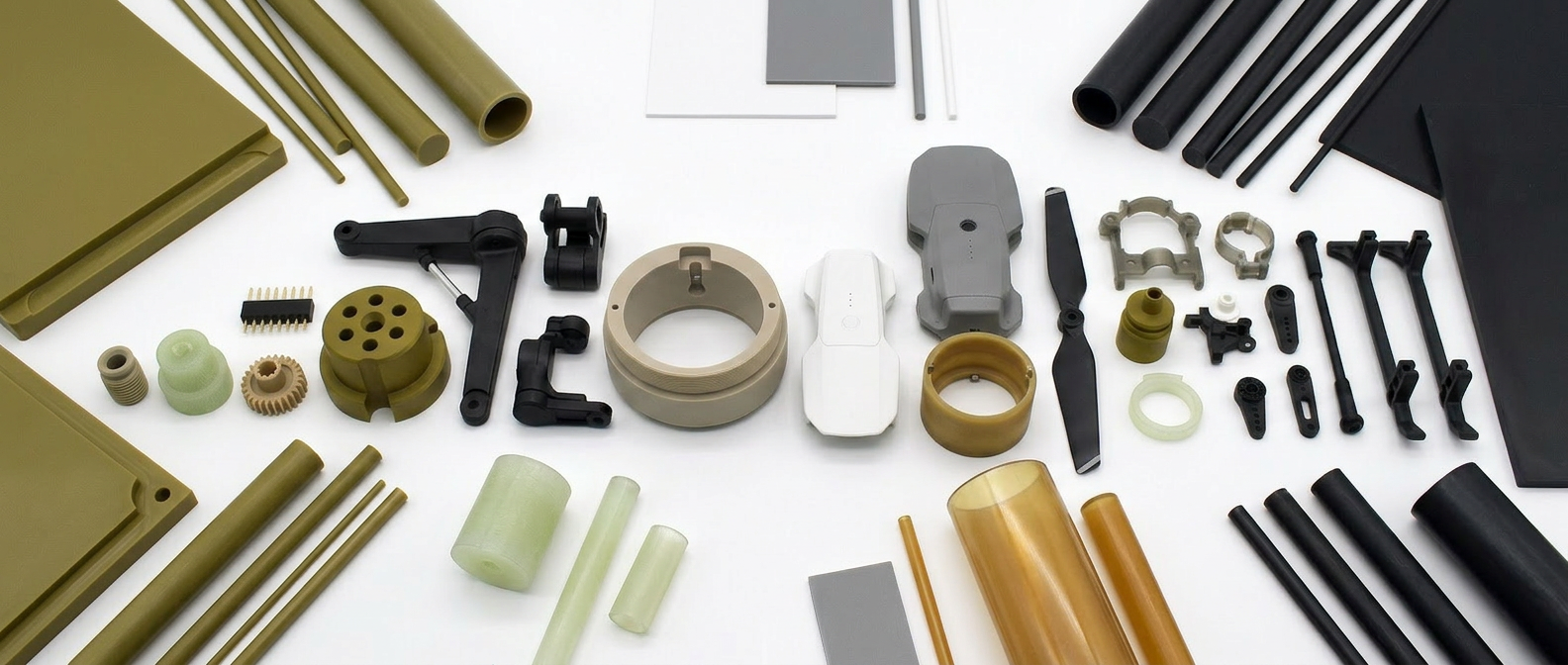
This article highlights common plastic and composite materials used in today’s drone industry for machined and molded parts, along with the applications where each material provides the greatest benefit.

Why Plastics Are Used for Drones
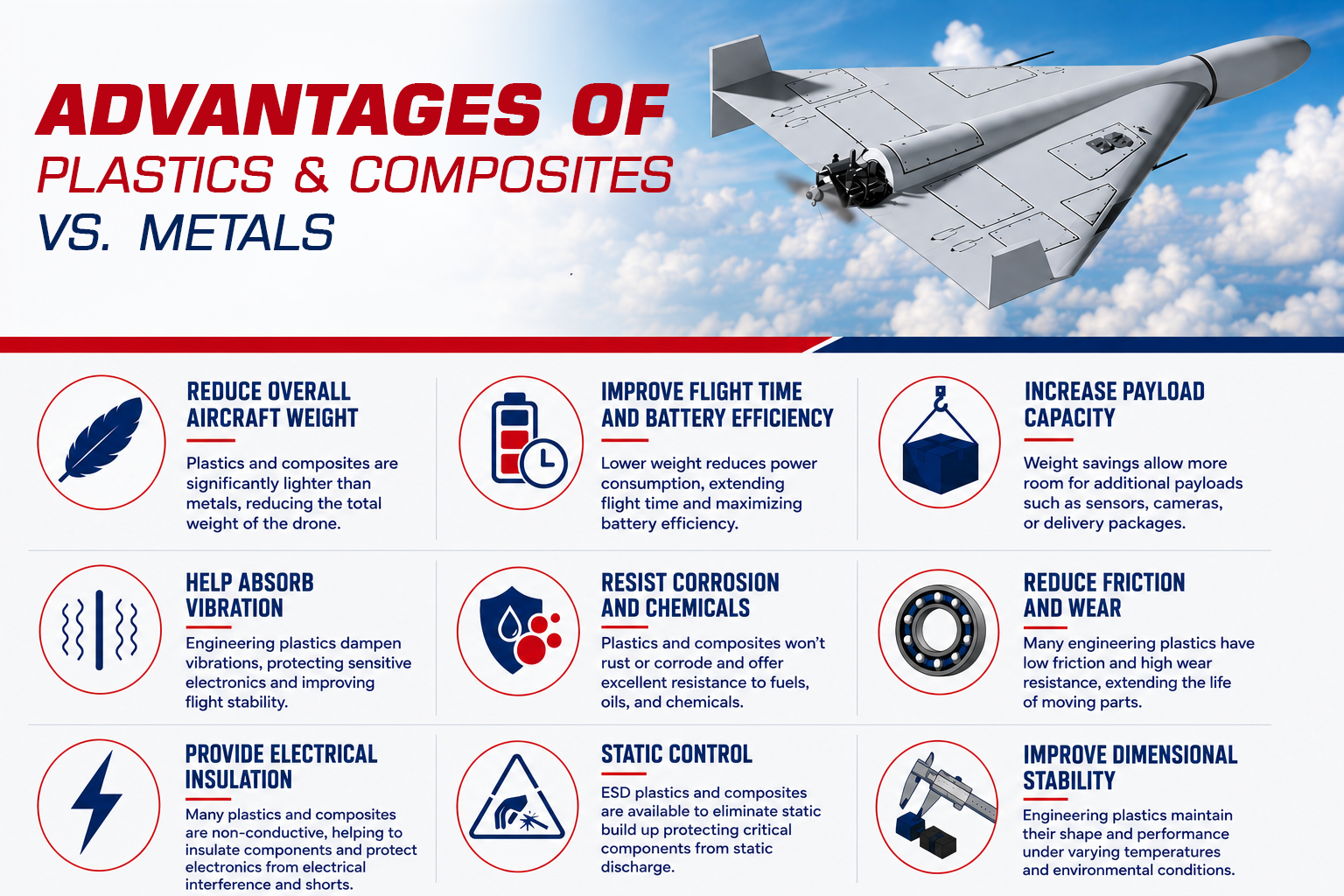
Every component on a drone contributes to overall weight, structural performance, and reliability. While metals continue to play an important role in aerospace structures, engineering plastics and composites are increasingly selected for many components because they provide performance advantages that conventional materials often cannot.
The infographic below highlights many of the advantages plastics and composites can offer compared with metals in drone applications.
Where Engineering Plastics Improve Reliability
Today, plastics and composites are commonly used in drone airframes, structural brackets, landing gear, battery enclosures, electronics housings, camera systems, bearings, gears, bushings, antenna components, and numerous internal support structures.
For industrial and military UAVs, engineering plastics can also improve reliability in environments where moisture, dust, chemicals, vibration, and temperature extremes are common.
Common Drone Applications for Plastics and Composites
- Structural components: Airframes, rotor arms, landing gear, brackets, battery supports, and payload structures.
- Motion and wear parts: Bearings, gears, bushings, rollers, cable guides, and other low-friction components.
- Electrical and RF parts: Electronics housings, insulators, antenna components, radomes, and avionics mounting plates.
Common Plastic and Composite Materials Used in Drones
Modern drones use a wide range of engineering plastics and composites, with each material selected to optimize a specific combination of weight, strength, wear resistance, dimensional stability, thermal performance, electrical properties, and cost.
No single material is ideal for every component. Structural airframes typically require lightweight materials with high stiffness, while gears and bearings demand excellent wear resistance and low friction. Electronics housings often prioritize electrical insulation and heat resistance, while RF components require materials with outstanding dielectric performance.
Understanding these tradeoffs allows engineers to select the best material for each application, improving overall aircraft performance, reliability, and service life.
The following comparison summarizes widely used plastic and composite materials for drone applications. It highlights engineering properties commonly evaluated during material selection, along with typical UAV applications where each material is frequently specified.
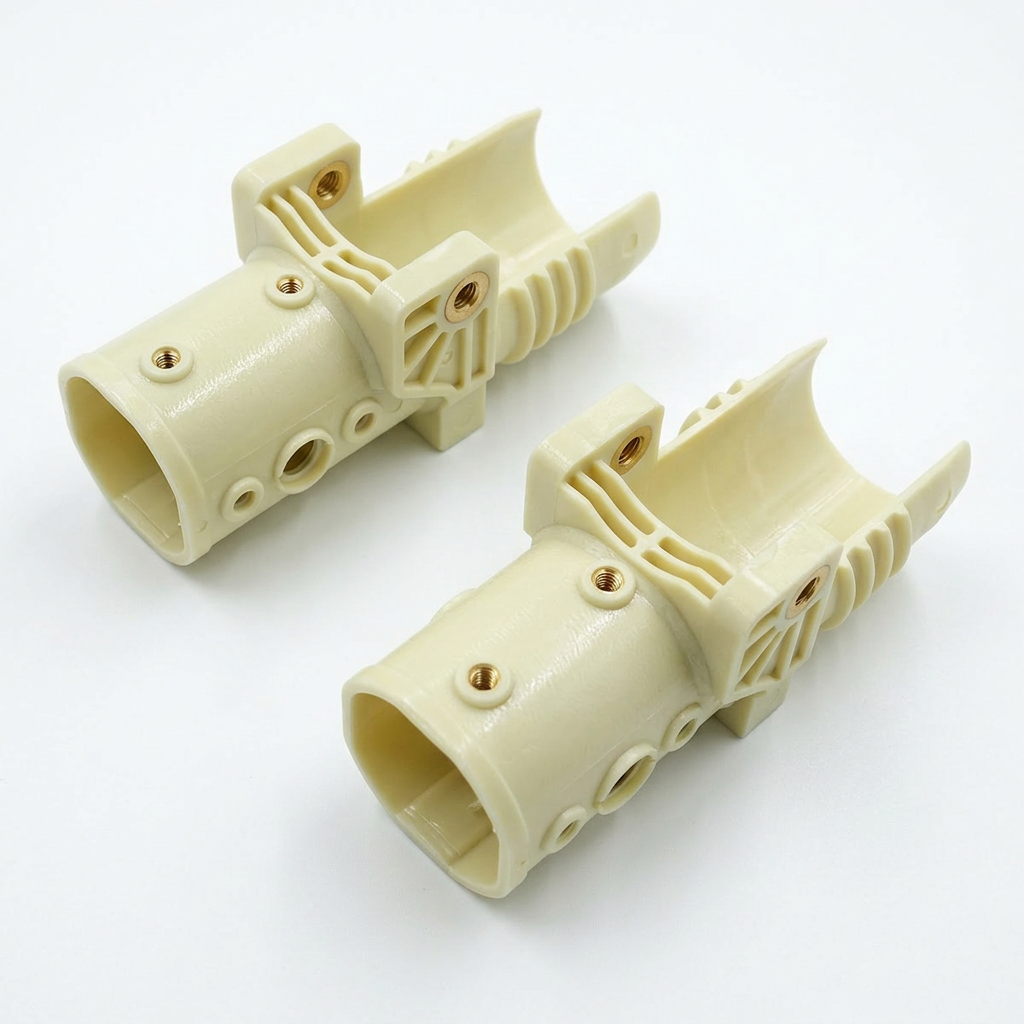
Drone Material Property Comparison
| Material | Density lb/in³ |
CLTE (×10⁻⁵ in/in/°F) |
Water Absorption 24 hrs (%) |
Heat Deflection Temp @ 264 psi (°F) |
Compressive Strength (psi) |
Tensile Strength (psi) |
Dielectric Strength (V/mil) |
Key Properties | Typical Drone Applications |
|---|---|---|---|---|---|---|---|---|---|
| Acetal (POM) | 0.051 | 5.4 | 0.2 | 220 | 15,000 | 9,500 | 420 | Excellent dimensional stability, low moisture absorption, low friction, excellent wear resistance, good machinability, and high strength. | Precision gears, bushings, rollers, servo components, and linkages. |
| Carbon Fiber Composite | 0.050–0.060* | 0.1–0.3* | <0.05* | >400* | 70,000+* | 80,000+* | N/A | Exceptional stiffness-to-weight ratio, very low weight, outstanding fatigue resistance, low thermal expansion, vibration damping, and corrosion resistance. | Airframes, rotor arms, wing structures, and payload supports. |
| G-10 / FR-4 | 0.065 | 0.55 | 0.1 | N/A | 65,000** | 45,000** | 800 | High mechanical strength, vibration damping, RF transparency, excellent electrical insulation, dimensional stability, low moisture absorption, and flame resistance. | Avionics mounting plates, battery trays, electrical insulation panels, and frame components. |
| Nylon 6/6 | 0.042 | 5.5 | 0.3 | 200 | 12,500 | 12,000 | 400 | High strength, good wear resistance, excellent toughness, fatigue resistance, good machinability, and low weight. | Structural brackets, gears, spacers, and cable clamps. |
| PEEK, 30% Carbon Filled | 0.051 | 1.0 | 0.06 | 550 | 29,000 | 19,000 | N/A | Very high stiffness and strength, lower thermal expansion, excellent wear and chemical resistance, high-temperature performance, and improved dimensional stability. | Airframes, motor mounts, structural supports, and lightweight load-bearing components. |
| PEEK, Bearing Grade | 0.052 | 1.7 | 0.05 | 383 | 26,700 | 11,000 | N/A | Excellent chemical resistance and wear properties, high limiting PV, high-temperature performance, low wear on mating parts, lower thermal expansion, and very low moisture absorption. | Bearings, bushings, thrust washers, gears, and sliding components. |
| PEEK (Virgin) | 0.047 | 2.6 | 0.1 | 320 | 20,000 | 16,000 | 480 | High strength, excellent chemical and hydrolysis resistance, high-temperature performance, low moisture absorption, excellent wear resistance, and outstanding electrical properties. | Bearings, bushings, gears, structural brackets, and electrical insulators. |
| Polycarbonate (PC) | 0.043 | 3.9 | 0.12 | 270 | 12,000 | 9,500 | 390 | Excellent impact resistance, high toughness, dimensional stability, transparency, and good electrical insulation. | Camera covers, electronics housings, sensor windows, and protective shields. |
| Rexolite® 1422 | 0.038 | 3.8 | 0.08 | N/A | 12,000 | 9,000 | 500 | Extremely low dielectric constant, ultra-low RF signal loss, excellent dimensional stability, low moisture absorption, low weight, and excellent electrical properties. | RF antenna components, GPS housings, radomes, and microwave components. |
| UHMW-PE | 0.034 | 11 | <0.01 | 116 | 3,000 | 5,800 | 1,150 | Outstanding abrasion resistance, low coefficient of friction, excellent impact resistance, self-lubricating performance, low moisture absorption, and chemical resistance. | Landing skids, wear strips, cable guides, and protective bumpers. |
| ULTEM™ 1000 (PEI) | 0.046 | 3.1 | 0.25 | 400 | 22,000 | 16,500 | 830 | High strength, excellent dimensional stability, high heat resistance, flame resistance, hydrolysis resistance, and excellent electrical insulation. | Electronics housings, avionics enclosures, battery enclosures, and sensor housings. |
| ULTEM™ 2300 (30% Glass Filled PEI) | 0.055 | 1.1 | 0.21 | 410 | 32,000 | 17,000 | 770 | Higher stiffness than unfilled PEI, excellent dimensional stability, high compressive strength, low thermal expansion, flame resistance, and high-temperature capability. | Structural brackets, electronics mounting plates, and avionics supports. |
* Carbon fiber composite values vary by grade and reinforcement orientation. ** G-10/FR-4 is a composite laminate sheet. The tensile value is reported in the lengthwise orientation and the compressive value in the perpendicular orientation, reflecting the higher values associated with glass fiber orientation. Property data is for technical reference and should be validated for the specific grade, geometry, environment, and application.
Selecting the Right Material for Drone Applications
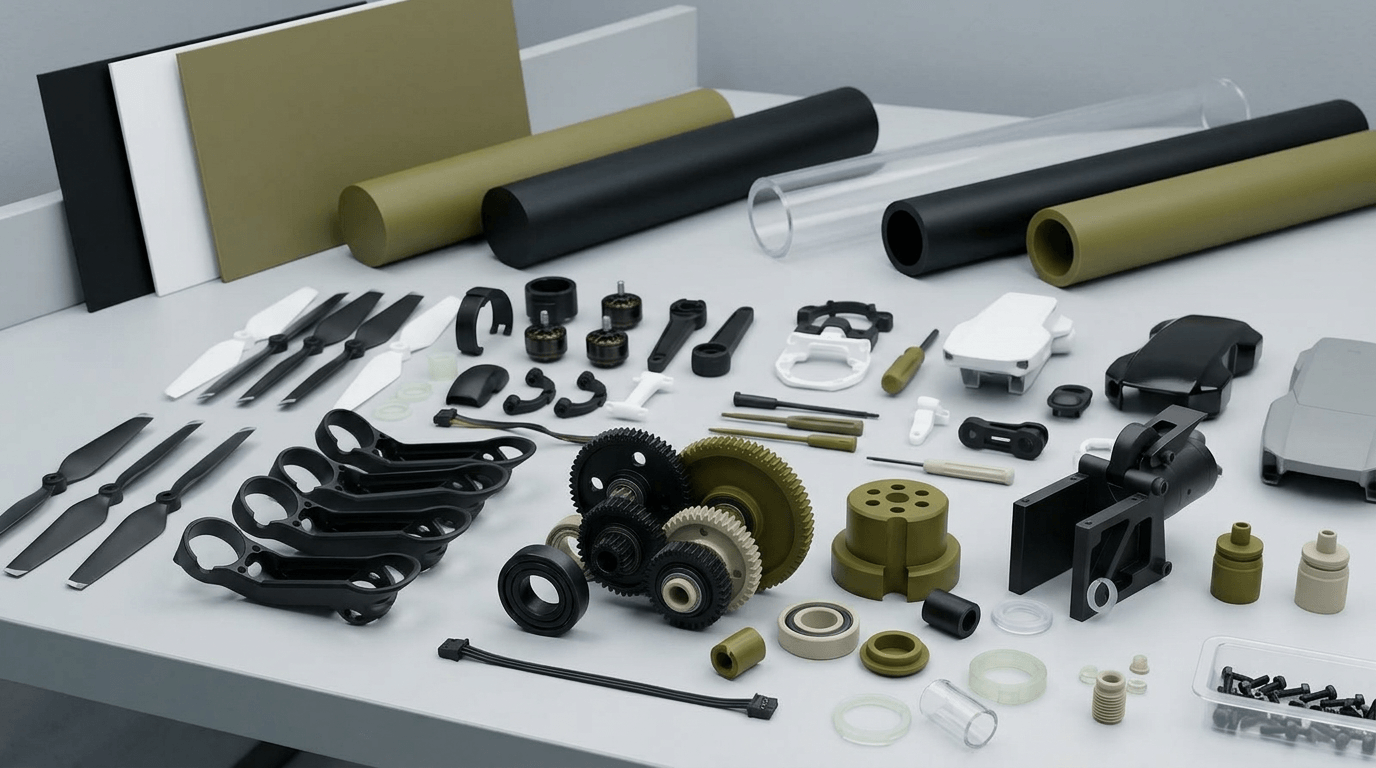
There is no single “best” plastic for every drone component. Material selection depends on the operating environment, structural requirements, electrical performance, manufacturing method, and cost objectives.
Understanding the strengths of each material helps engineers optimize weight, durability, manufacturability, and long-term performance throughout the aircraft.
Examples of Material Selection by Application
- Carbon fiber composites are often selected for lightweight structural components where stiffness-to-weight ratio is critical.
- PEEK grades are used where high temperatures, wear resistance, chemical resistance, and strength are required.
- Acetal is frequently selected for gears and precision motion components because of its dimensional stability and low friction.
- ULTEM™ PEI is well suited for electronics and avionics housings requiring heat resistance and electrical insulation.
- UHMW-PE excels in impact, abrasion, and sliding wear applications such as landing skids and cable guides.
- Rexolite® provides specialized electrical and RF performance for antenna, GPS, radar, and communication components.
- G-10/FR-4 provides high strength, vibration damping, RF transparency, and excellent electrical insulation for mounting plates and structural parts.
- Extreme-performance materials, including Torlon®, DuPont™ Vespel®, and Celazole® PBI, are available for the most demanding temperature and performance requirements.
Plastic Materials for Drones FAQs
Plastic Materials and Manufacturing for Drone Parts
Engineering plastics and composites are available in a variety of manufacturing forms to support both prototype and production programs. Depending on the application, components may be machined from plastic or composite sheet, rod, and tube stock or produced through injection molding for higher production volumes.
Boedeker Plastics supplies high-performance plastic and composite materials and manufactures precision CNC machined plastic and composite components and injection molded plastic parts for demanding commercial, industrial, aerospace, and defense drone applications.
- Prototype-to-production CNC machining using plastics and composites only
- Injection molding for repeatable production and complex integrated features
- Material selection and engineering support based on the application’s mechanical, thermal, electrical, and environmental requirements